Local Retail Business: Definition, Challenges and Tips for Success
Local retail is at the heart of community life. Independent delis, wine merchants, florists, artisan bakeries, greengrocers: these businesses form the economic and social fabric of our towns and villages. Yet, in the face of rising e-commerce and pressure from supermarket chains, succeeding in local retail today requires a clear strategy.
This complete guide covers the fundamentals of local retail, its strengths, its challenges and all the levers available to increase sales and build lasting customer loyalty.
Stay informed about our offers and professional advice
? 6 min read | Published: 08/06/2026
What Is a Local Retail Business?
A local retail business is a physical point of sale located close to its customers, typically in a residential neighbourhood, a high street or a market town centre. It differs from large retail chains through its smaller size, strong community roots and the personalised relationship it builds with its customers.
Its catchment area is generally limited to a few hundred metres to a few kilometres. This geographic and human proximity is precisely what gives it its main competitive advantage over national chains.
? Key takeaways
A local retail business draws its strength from community roots and direct customer relationships.
A small catchment area is both a constraint and an opportunity: every loyal customer is worth far more than an occasional supermarket shopper.
Types of Local Retail Businesses
Local retail covers a wide range of activities. The main categories are:
Food and drink retail: bakeries, butchers, delis, greengrocers, wine merchants, cheesemongers, fishmongers. These are the most frequently visited local businesses.
Service-basedretail: hairdressers, dry cleaners, cobblers, pharmacies, opticians, florists. They meet regular needs and generate naturally loyal customers.
Specialist retail: bookshops, homeware boutiques, independent clothing, stationery, toys and games. They compete on expertise and personalised advice.
Cafés and neighbourhood restaurants: bars, pubs, bistros and independent restaurants that play as much a social as a commercial role.
Each type of local retail business has its own codes, seasonality and performance drivers. But all share the same fundamental challenge: creating a customer experience that neither Amazon nor the local supermarket can replicate.
What Role Does Local Retail Play?
Local retail businesses fulfil functions that go well beyond the simple commercial transaction:
An economic role: they generate local jobs that cannot be offshored, support local supply chains and contribute to the tax base of their communities.
A social role: local shops are places of connection, encounter and exchange. The retailer-customer relationship is often one of lasting trust.
An urban role: active local retail maintains the attractiveness of a high street or neighbourhood, limits commercial decline and preserves mixed-use vitality.
An environmental role: buying local reduces transport distances and aligns with more responsible consumption, an argument increasingly valued by customers.
Do you have a layout project?
If you wish to furnish your commercial space, our team will provide you with personalized support throughout your project.
Competition has never been more intense for local retailers. E-commerce is capturing a growing share of purchases, particularly in clothing, books and electronics. Supermarket chains exert constant price pressure.
Yet local retail businesses are proving more resilient than expected, provided they activate the right levers to drive sales growth:
Advice and expertise: a wine merchant who guides customers through a selection, a cheesemonger who introduces local producers create added value that no algorithm can replicate.
Freshness and quality: consumers are increasingly sensitive to provenance and quality. Local retail can make this its central differentiating argument.
Agility and flexibility: adapting the offer, creating tailored services (click and collect, themed hampers, local delivery) allows local retailers to optimise sales without heavy investment.
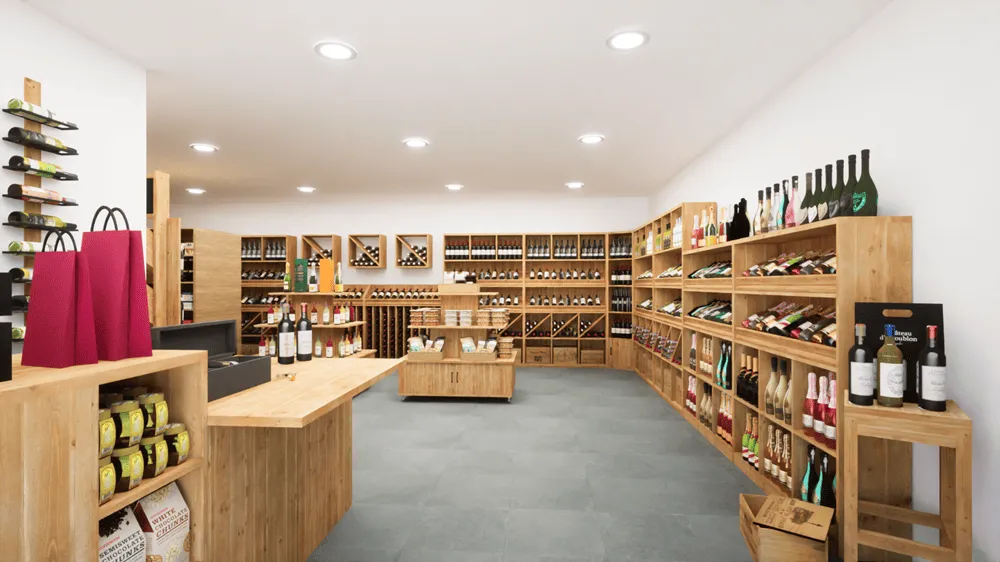
The in-store experience: shop layout, furniture quality and product presentation play a decisive role in perceived value and the purchase decision.
How to Open a Local Retail Business
Opening a local retail business follows the same broad steps as any commercial project, with a few specificities linked to community anchoring:
Validate local demand: before launching, confirm that a genuine gap exists in your target area. A deli in an already well-served neighbourhood will be harder to make profitable than a greengrocer in an area that lacks one.
Choose the right location: in local retail, daily pedestrian flow matters more than occasional footfall. Prioritise locations on commuter routes, near public transport or schools.
Define your positioning: a local retail business cannot sell everything to everyone. A clear positioning (range, price point, product provenance, atmosphere) is essential to increase sales sustainably.
Invest in your shopfit: professional furniture, signage and product presentation are your first sales argument. A well-designed space with solid wood fixtures creates a warm atmosphere that brings customers back.
Complete the formalities: register your business with Companies House or HMRC, sign a commercial lease, obtain activity-specific licences (food business registration, personal licence for alcohol retail).
How to Attract and Retain Customers
This is the central question of any strategy to increase sales in local retail. Here are the most effective levers:
Work your shopfront: your window display is the first point of contact with passing customers. Refresh it regularly, ensure it reflects your identity and makes people want to come in.
Build community connections: participate in neighbourhood events, join local traders' associations, engage on local social media. A local retail business that is visible in its community naturally attracts more customers.
Implement a loyalty programme: loyalty cards, regulars-only benefits, personalised offers. Loyalty building is the most cost-effective lever to increase sales: a loyal customer spends on average 3 to 5 times more than a new one.
Offer complementary services: click and collect, local delivery within a limited radius, pre-order services. These strengthen the customer relationship and boost sales without heavy investment.
Perfect the in-store experience: welcome, advice, shelf layout, ambient sound and scent. Every detail counts in the decision to return.
Running Your Local Business Day to Day
How to increase sales sustainably? The answer often lies in the rigour of daily management:
Manage stock precisely: out-of-stock situations lose sales and undermine credibility. Regular monitoring of stock rotation and reorder levels is essential.
Track your key indicators: daily turnover, average basket value, footfall, margin by product category. These figures guide your decisions to optimise sales week on week.
Adapt to seasonality: high-performing local retail businesses adjust their range, window displays and promotions to the rhythm of seasons and local events.
Train and motivate your team: in a local retail setting, every member of staff is a brand ambassador. The quality of welcome and advice depends directly on their engagement.
Invest in fixtures and layout: a well-structured shop with quality professional solid wood furniture maximises display space, improves customer flow and directly contributes to increasing sales.
Tiffany Sarrazin
As Managing Director of Tradis, she leads the company's development and shares her expertise in solid wood furniture through advice and content for professionals.
 Shelves



.webp)


_11zon.webp)
.webp)